

The Colors from the Mud

Updated: May 27
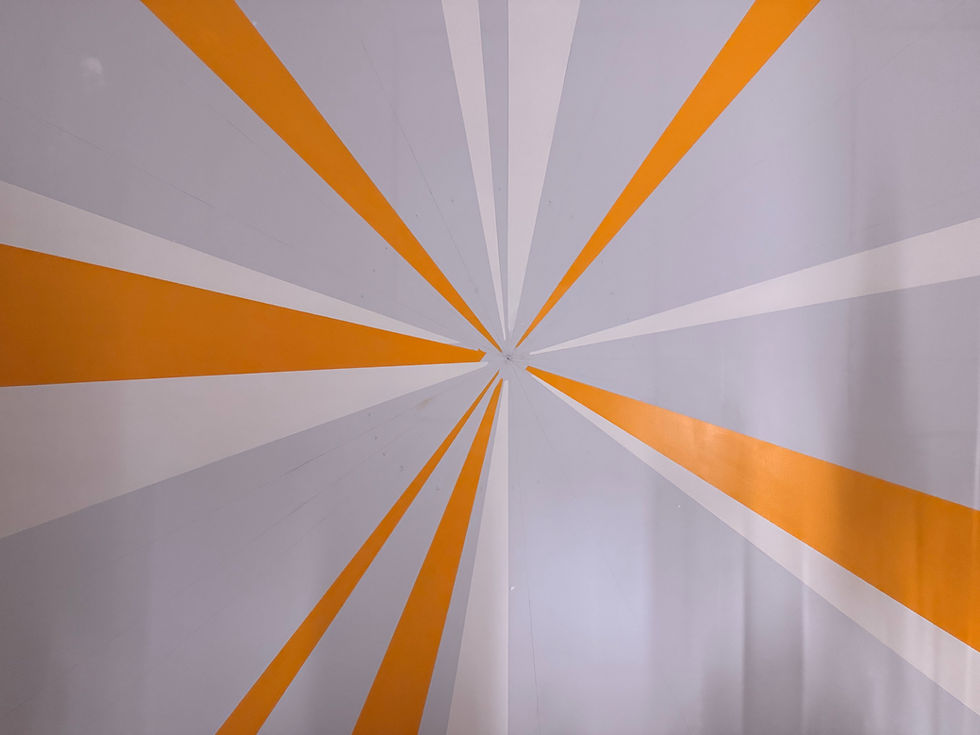
I recently painted a lotus at the center of my wall, surrounded by rays of color. Beyond the lotus as a symbol of rising from the mud, each ray symbolizes a lesson I learned during the hardest year of my life.


I won’t share all the details. Some stories are still too painful; others aren’t mine to tell. There were moments I felt completely buried in the mud, exhausted, physically ill, and emotionally overwhelmed. I struggled to hold together parts of my life that seemed to be falling apart in all directions.
Yet, moments of beauty appeared.
This isn’t advice. This is a continuation of my processing by reflecting on what helped me get through the mud: what softened me and brought me back to myself. Maybe some of this will resonate with someone else sitting in the mud, too.
Grow
When I am challenged with something, I often turn to books. I love learning new ways of seeing things and finding stories from people whose experiences resonate with or inspire me. When I turned to books on change, I found many inspiring stories about people who rose from an unexpected change or bump (read: mountain) in the road and became better for it. Part of me felt hopeful reading these stories. Another part felt pressure. Pressure to use this time to grow. To evolve into some bigger, better, stronger version of myself.

Eventually, I realized that pressure wasn’t serving me. I didn’t have the energy to turn my pain into a self-improvement project. I needed to let go of becoming and simply survive a difficult time.
And that made me wonder: what if the real evolution wasn’t becoming someone new, but coming back to myself? What if growth could mean trusting that the strength and courage I needed were already inside of me?
White is the reflection of all colors. Throughout this year, so much of myself was exposed and reflected back to me. Not all of it was easy to see. But over time, and with a lot of processing, I started noticing what I no longer needed to carry. I gave myself permission to start releasing what was keeping me from my true nature. My knowing. My truth. My home in myself.
Maybe growth can simply be moving through what you thought might break you.
In the midst of the challenges and needing to heal physically and emotionally, and while navigating extremely difficult situations, I picked up extra jobs to cover my mortgage and traveled for multi-day faculty interviews. I was meeting with people every hour, presenting, teaching, and needing to be “on.” I knew I needed to rest, and I did when I could. But first, I needed to protect my future.
So I did.
I showed up. I gave what I could. I tried to be present and open. And somehow, I could still experience connection. I could be myself, and people appreciated that. I appreciated them too. That felt healing.
That, to me, was growth.
I didn’t have to become someone else. I didn’t have to go through some magnificent transformation and emerge as a brand-new person. I just had to keep coming home to myself.
That experience uncovered a quieter strength in me. The kind that can sit in the mud without rushing to escape it. The kind that can be patient, present, and still. The kind that doesn’t strive to become, but remembers how to return.
Monarch Wing
I’ve always struggled with tying my value to my productivity. I can be hard on myself when I don’t feel “productive,” even when I’m supposedly resting. I bargain with myself: Just get this done, then you can take a break. As if rest has to be earned.
Even outside of work, I feel pressure to accomplish. Enjoying a book can become a need to finish it. Meditation can become another box to check off. And while that striving has helped me achieve in my academic and professional life, it has also burned me out.
And at a time I felt nearly extinguished, there wasn’t any more room to burn.
So I had to rest. Truly rest. Before everything (or anything) was finished. Before I felt caught up. Before I felt deserving of it.
That brought up difficult questions for me: who am I trying so hard to prove myself to? Who is setting these constantly moving standards for what it means to be successful, productive, enough?
I’m still figuring out what rest means to me. And I don’t think it necessarily means doing nothing. For me, rest can look like reading a book for fun in a café, going to a gentle yoga class, gardening, brewing my own kombucha, cooking with nourishing foods before taking my time to eat, exploring somewhere new, or having a deep conversation with someone. Sometimes it looks more active with hiking, running, and traveling. Things that help quiet my mind enough to be present.
The learning in yellow, the Monarch wing, reminds me of a caterpillar forming its cocoon. It knows when it’s time to pause. It doesn’t try to earn rest or force transformation. It allows nature to run its course.
Rest is not a reward for finally doing enough. Especially during difficult seasons, the body and mind need more softness, more stillness, more care than we may feel comfortable giving ourselves. Rest is what allows us to heal and repair.
Not as avoidance. Not as giving up. But as an act of kindness toward ourselves.
To respect where we are. To give our bodies and minds what they need when they need it.
You do not have to finish everything before you deserve rest. You deserve it as you are.
Fiery Sky
Last fall, I went camping at Lake Lure, an area that had been deeply impacted by Hurricane Helene and was still under repair when I visited. What I remember most, beyond the wonderful people there, was the lake. The water had been purposefully drained to remove debris left behind by the storm. In the middle of the exposed lakebed sat three cargo containers. On each, painted in bold letters, were the words:
FAITH. HOPE. LOVE.
It struck me. In a place marked by devastation, there was still faith. Still hope. Still so much love surrounding it all.

It made me think about how sometimes we need to drain the lake to see what’s sitting underneath, expose the debris, and clear it out before we can rebuild. Sometimes healing looks less like adding something new and more like removing what no longer belongs.
This year also forced me to look more honestly at myself, my relationships, and the ways I move through the world. One of the hardest parts was feeling as though I had lost trust in who I am.
I was caught in a strange whiplash of feedback. One day, I’d be told to be more confident, speak up more, and take up more space. The next, I’d be told I was too intense, too intimidating, moving too fast. I started shaping myself around someone else’s expectations.
Be visionary, but not too visionary.
Be warm, but not too warm.
Be driven, but not too driven.
Be a leader, but not too much.
The more I tried to perfectly calibrate myself for everyone around me, the more disconnected I became from myself. I started losing parts of myself I loved — my creativity, my spark, my openness, my instinct to dream big, and my ability to make it happen.
Constantly shrinking and reshaping yourself to manage other people’s comfort is its own kind of suffering. It leaves you fragmented. Exhausted. Unsure of your own instincts.
It isn't always easy, but it is possible to be reflective and compassionate without abandoning myself in the process. I can listen to feedback without losing my center. I can care deeply about others without making myself smaller to accommodate everyone around me.
There were moments I wanted to disappear into a quieter life away from conflict and expectations. But healing doesn't come from running away. It comes from allowing the storm to weather you without losing yourself inside of it. Letting it wash away what was never truly yours to carry.
If I want to do meaningful work in this world, I cannot build it on fear, self-abandonment, or the need to make myself smaller for others. I have to stay grounded in who I am. Strong enough to stand up for myself, soft enough to remain loving, and brave enough to take up space without apologizing for it.
It still doesn’t always feel comfortable. Staying true to ourselves is worth practicing anyway.
Cosmic Pink
The body often knows long before the mind is ready to admit something.
I tend to think my way through problems. To stay hopeful. To give the benefit of the doubt. To push through discomfort and trust that things will eventually work themselves out.

But eventually, my body stopped letting me negotiate with myself.
What started as stress became a physical illness. There were periods when my symptoms were so debilitating that I couldn’t leave my house. Most of it manifested in my stomach, though it felt like issues were arising throughout my whole body, trying to carry what I could not fully process emotionally.
I tried everything I could think of to heal: doctors, medications, restrictive diets, supplements, meditation, prayer, Western medicine, homeopathy, bioenergetics. But I didn’t find any relief until I finally stepped away from one of the most painful parts of my life. And that timing didn’t feel like a coincidence.
For a long time, I tried to override my instincts. I wanted to believe the best in people. I wanted to keep giving chances. And I don’t think that hopefulness is a bad thing. But there’s a difference between being compassionate and abandoning yourself.
Sometimes doing the right thing feels terrifying, especially when you care deeply, when you have something to lose, or when walking away means giving up something you’ve put your all into and stepping into the unknown.
I also find myself thinking differently now about performance and optimization. In a world of asking how to be more efficient, productive, and stronger, what if the better question is not What should I do? But how do I better understand myself? How do I become more connected to my own body, intuition, and needs so I can build a life that actually supports me instead of constantly overriding myself?
Part of that connection is also allowing ourselves to be supported by others.
A strange part of this year was needing more support than I could give back. For the first time in my life, I did not have the capacity to hold everything on my own. My family and friends showed up for me in the best ways they could. I couldn’t have gotten through this year without them.
Accepting love and support without instantly giving back felt uncomfortable. But it was required to heal, and reminded me that we were never meant to face life alone.
Blue Ember
A friend recently shared that Indigenous communities carry embers with them on their travels to rekindle fires at their next stop. Someone must safeguard the ember along the way, shielding it from wind and rain to keep it burning.
This year, I realized how crucial it is to protect our own ember.
Our energy, softness, creativity, and peace—the inner spark that makes us feel alive.

I’m still very much in the thick of practicing what boundaries mean to me: not walls or shutting others out, but safeguarding the parts of myself requiring care. Learning how to be both kind and firm at the same time.
Listen to what people show you about themselves through the way they treat others. Sometimes you meet people who make others feel more alive — more creative, safer, more inspired, more connected to themselves. Being around those people fuels your spirit. It reminds you who you are. Those were the people who helped keep my ember alive this year.
But the opposite matters too. For too long, I convinced myself that, despite the discomfort I felt when watching certain patterns of cruelty, volatility, disrespect, or worse, I would somehow be exempt from them. That if I were kind enough, understanding enough, patient enough, things would be different. It took me a long time to stop explaining away what I consistently saw, and by then, I had already lost a lot of myself in the process.
No matter how deeply you want to see the good in someone, it does not mean you have to continuously sacrifice parts of yourself in the process. Compassion and boundaries can exist together.
Your ember deserves protection.
Notice when it dims, and nourish it before it burns out.
Spirit Blue
There was a period this past year when I felt like I lost part of my spirit. The world felt grey. I felt grey. Color is trickling back in, but some days are still grey.
It was hard to realize at first because it happened so slowly. After enough stress, hurt, exhaustion, and self-doubt, I started feeling disconnected from myself and from the things that usually made me feel alive.
The color hasn’t suddenly come back all at once, either. It’s taken close to a year to start feeling more like myself again. And even now, there are still grey days.

Part of me feels proud of myself for getting through everything that happened. Another part feels sadness, shame, or frustration that I let certain patterns repeat for as long as they did. But being human allows both strength and weakness to coexist.
Protecting your spirit matters. Hold on to the parts of yourself that feel alive, curious, loving, creative, and hopeful. Continue to believe in your own goodness and the goodness of the world, even after experiences that make you question both.
Part of keeping your spirit alive is choosing to trust again. Trusting that painful experiences do not make you bad or broken. Trusting that healing is possible, even when you cannot fully see it yet. Trusting yourself enough to be vulnerable again after losing yourself for a while. Trusting that even the most painful experiences can hold meaning. That there is something to learn, even if you cannot see it clearly yet.
Nevermore
Everyone has a limiting belief. Mine happens to be the belief that I am not enough. Not smart enough. Special enough. Worthy enough. And the list could continue.
I’ve spent so much of my life thinking that maybe if I worked hard enough, achieved enough, I would finally arrive at a place where I felt content. But (surprise) that feeling didn’t arrive.
During a talk with my career coach, we identified that my anxiety, self-doubt, and perfectionism stemmed from the same core belief. Although I had seen its impact in my relationships and had been working on that for several years, it was frustrating to realize how many other areas of my life still made me feel I needed to prove my worth.

After that talk, I searched Pinterest for a wallpaper that said, “You are enough,” that I could use as a daily reminder. One variation brought me to tears:
“You have always been enough.”
This wasn’t just about who I am now. It was about the little version of me that spent years trying so hard to be perfect so she could feel worthy of love and acceptance. And suddenly, I felt so much sadness for her. And wanted her to know she can rest now, too. Because she always was enough.
Part of me fears letting go of this belief completely. Like if I stop listening to this belief, I’ll somehow stop growing, caring, or reaching my potential. But surely there’s another way to move through life. To care deeply, work hard, dream big, but do it from a place of love rather than fear. To believe that my worth is not something I have to earn.
I don’t know if this belief will ever disappear entirely. But it’s getting quieter. And more importantly, I don’t let it control my life as much as I once did.
We can’t expect to eliminate every insecurity, but we can learn not to build our identities around them.
Nevermore to me is nevermore allowing the voice that says I am not enough to be the loudest one in the room.
Beauty from Mud
Healing is not linear. Growth is not always graceful. Sometimes it looks like rest, walking away, beginning again, or simply surviving.
The lotus reminds me that something beautiful can still grow through difficult seasons. We don't need to emerge flawlessly from the mud, but we can trust that beauty can still grow within it.
And maybe slowly, through the mud, we find our way back to ourselves.


Comments